Jessica: Talk to the Land
Every property conversation begins before the first question is spoken. There is a boundary on the ground, a history behind the address, a pattern in the surrounding streets, and a person trying to decide what matters.
Jessica gives that conversation a calm front door. Instead of asking users to translate ordinary language into a maze of filters, she lets them begin naturally: Who owns this? What changed? What should I notice? How does this parcel compare? The answers stay connected to VistaView, where maps, property context, valuation, visuals, and documents can continue the work.
The category is moving in this direction. Land id’s AI Insights and PropStream’s Intelligence and AI Search products reflect a wider appetite for plain-language property research. They are useful signals about the market, not opponents in a staged scorecard. VistaView’s point of view is that conversation becomes more valuable when it can travel gracefully into the rest of the property journey.
Our method is clear: we take public data, aggregate it, and add the specialty of our engines—Jessica, Super Map, valuation, visuals, and VistaSign. The interface then shows the details a user needs to judge an answer: source, confidence, and date.
Open the live surface: https://vistaview.ai/v3/platform/jessica-ai — sign-in may apply.
An answer with its evening clothes on—and its receipts
Beautiful software should not ask for blind faith. Jessica’s most important visual habit is the stamp beside the statement. Source tells the user where the visible fact comes from at a meaningful public level. Confidence communicates how firmly the system can stand behind the match or conclusion. Date tells the user whether the fact belongs to today’s conversation or an earlier chapter.
Together, those stamps turn a chat response into something an agent can discuss. They do not make every record perfect, and they do not replace verification for a consequential decision. They make uncertainty legible.
Imagine a listing appointment. The seller asks why a property detail appears, when an ownership event occurred, or how current a value signal may be. “The computer said so” ends the conversation. A visible source, confidence, and date gives the professional a better answer: here is what VistaView is showing, here is how certain the match is, and here is when the information was current.
That is the difference between decorative intelligence and usable intelligence.
Begin with the property, not an empty prompt
Real Estate Intelligence gives Jessica a setting. Search an address, owner, or property and the conversation begins with context already in view. The experience can move through characteristics, ownership, transfers, tax context, neighborhood signals, and related property questions without treating each answer as a disconnected message.
This is not a promise that every question has a definitive answer. Property information changes, public records can lag, and names can be ambiguous. The product is at its best when it helps the user narrow a question, see the evidence, and know what to verify next.
The visual language matters. Forest green quiets the workspace. Thin gold frames separate the current property from supporting detail. The typography gives a short answer room to breathe, while stamps and links keep the path to evidence close. Jessica should feel like a composed research partner, not a slot machine for paragraphs.
Super Map: point, draw, and ask
Language becomes more precise when it can touch the map. Super Map provides the spatial half of the conversation: parcels, boundaries, nearby context, and drawing tools. A user can begin with a known address, select a parcel, or shape an area of interest, then continue in plain language.
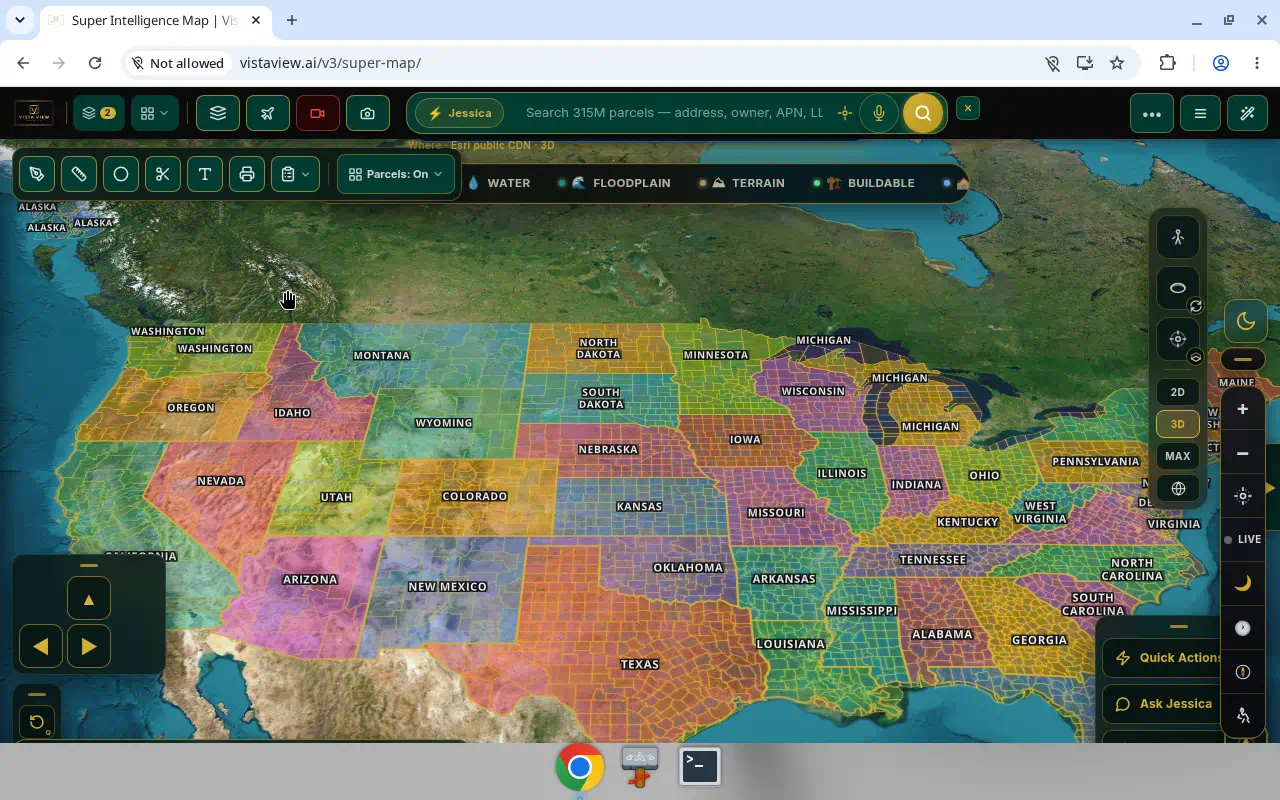
This pairing is powerful because property questions are rarely only textual. “Show me similar opportunities nearby” has a geographic meaning. “What sits behind this frontage?” is easier to understand when the parcel is visible. “Which holdings belong together?” may require both an ownership view and a map.
Jessica does not need to pretend the map is a footnote. The map is part of the sentence.
Valuation with the proper title
Value questions arrive quickly in any property conversation. VistaView’s Home Valuation experience can add a value signal and supporting context, including markets where public sale detail may be limited.
The title must remain precise: an automated valuation is decision-support, not an appraisal. It can help an agent prepare, help an investor compare, or help an owner frame the next question. It cannot replace a licensed appraisal, lending review, inspection, or professional advice tailored to a transaction.
Jessica’s role is to help explain the visible context without turning an estimate into certainty. Date and confidence are especially important here. A refined presentation should make the boundary obvious: this is an informed signal for a decision process, not a stamped conclusion about value.
From question to action, without breaking the scene
A conversation about land is valuable because of what can follow it.
A user may move from Jessica to an ownership view, then open a portfolio associated with the owner. A transfer question may lead into deed history. A listing idea may continue into Listing Studio and a gold buyer page. A floor plan may become a walkable 3D experience. A document may move into VistaSign for review and signature.
The continuity is the product story. Jessica runs on VistaView and remains part of VistaView. The user does not need a technical lecture to understand the benefit; the benefit is visible in the handoff.
Private contact detail is handled with equal clarity. Owner phone and email information is not public; it is available when you are signed in on a paid plan, with a record of access. A conversational interface does not turn a restricted detail into an open one.
Category context without invented victories
Land id’s AI Insights emphasizes property understanding in a mapping experience. PropStream’s Intelligence and AI Search experiences emphasize conversational investor research and turning descriptions into search criteria. VistaView combines Jessica with Super Map and connects the answer to presentation, valuation, visual, ownership, and signing experiences.
That is a difference in product shape, not a numeric verdict. There are no fabricated accuracy scores here, no unverified speed contest, and no claim that every professional should use the same tool. The right comparison is experiential: open the products, ask the same careful question, examine what is visible, and decide which journey supports the work.
A five-minute way to evaluate Jessica
Choose a property you know well. Begin at Real Estate Intelligence, then ask Jessica one factual question and one interpretive question. Inspect the visible source, confidence, and date. Open the parcel in Super Map. Ask a follow-up that depends on location. Finally, open valuation context and note whether the experience preserves the distinction between a decision-support signal and an appraisal.
This simple evaluation reveals more than a long feature checklist. It tests whether the conversation stays grounded, whether uncertainty is visible, and whether the next surface feels connected.
Honest boundaries
Jessica is not an appraiser, attorney, surveyor, inspector, or title professional. Public information can be delayed or incomplete. A source stamp supports review; it does not eliminate the need to verify material facts. Conversational answers do not replace transaction documents, professional advice, or local requirements.
Those boundaries are part of the elegance. Confidence comes from presenting what the system knows, when it knows it, and where the human professional should take over.
FAQ
What is Jessica?
Jessica is VistaView’s conversational property assistant, connected to the platform’s map, intelligence, valuation, visual, and document experiences.
What do source, confidence, and date mean?
They are visible cues that help a user understand the origin, strength, and freshness of a displayed fact or match.
Is owner phone or email public through Jessica?
No. It is available when you are signed in on a paid plan, with a record of access.
Is VistaView’s valuation an appraisal?
No. It is decision-support, not an appraisal.
How should I compare Jessica with other property assistants?
Use the same real property question, inspect the supporting context, and compare how naturally each answer moves into your next task.
Talk to a property
Start at VistaView, then open: