The Ownership Graph, Made Visible
A parcel is never only a shape. It has a present owner, a sequence of earlier hands, relationships to other holdings, and signals that may matter to an agent or investor. The challenge is not merely finding a record. The challenge is seeing the relationship without losing the property at the center.
VistaView turns that relationship into a set of visible experiences: who owns, Owner Portfolio, Deed & Title, and distress filters. The user can begin with one address, move outward to the owner’s holdings, look backward through transfer history, or narrow a market by the conditions relevant to a strategy.
Behind that experience is a deliberately simple public explanation. We take public data, aggregate it, and add the specialty of our engines—Jessica, Super Map, valuation, visuals, and VistaSign. Those engines help connect people, companies, and parcels while the interface presents the result with source, confidence, and date cues.
This is the mechanism worth describing: not hidden machinery, but the path a user can actually walk.
First movement: ask who owns the property
Begin in Real Estate Intelligence or select a parcel in Super Map. The initial question may be as direct as Who owns this? The answer can open a property view with ownership context, characteristics, assessment and tax context, prior activity, and nearby perspective.
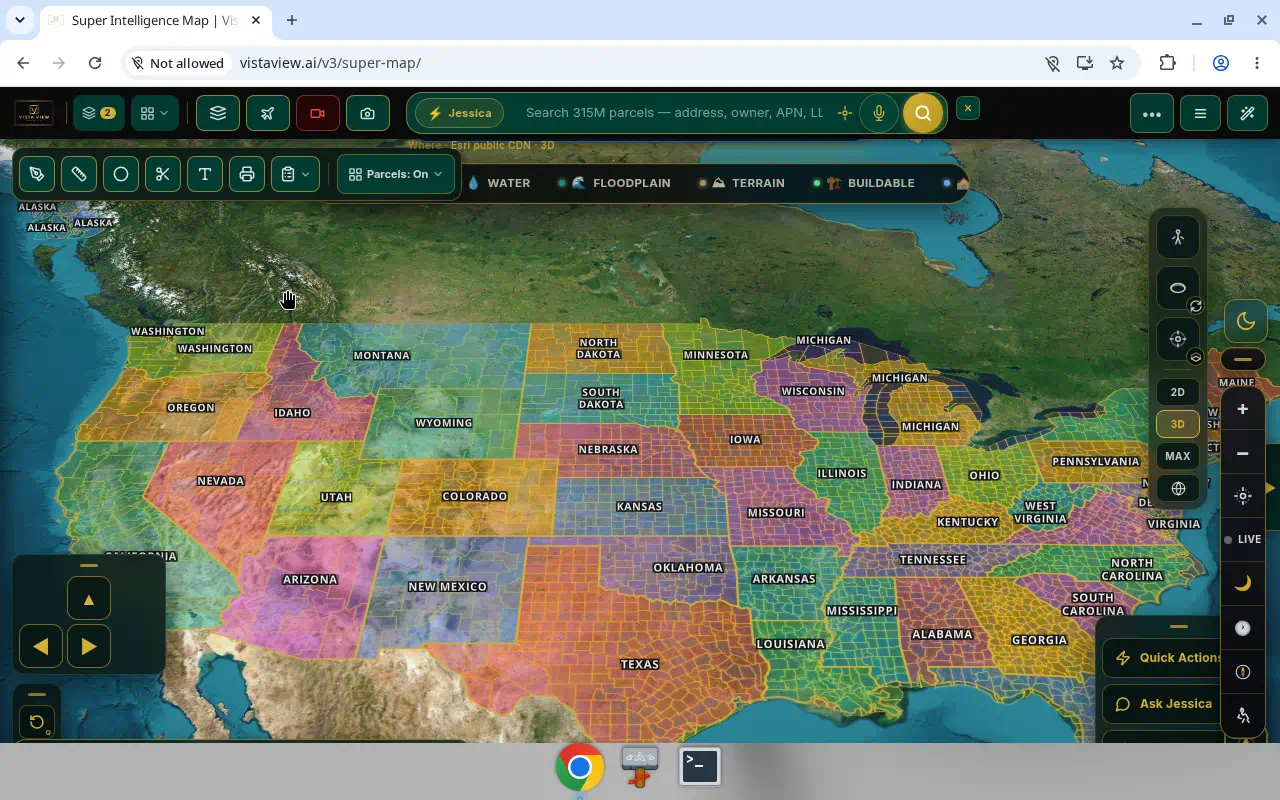
The experience should not feel like a pile of unrelated fields. The address and parcel hold the center. Ownership appears as part of the property story. Supporting details arrive in ordered sections, and the source, confidence, and date cues help the user decide which facts are ready for conversation and which require further verification.
The visual restraint is intentional. Forest green establishes calm; fine gold lines mark transitions and selected states. A dense research experience can still feel luxurious when hierarchy replaces clutter.
For agents, the immediate value is preparation. For investors, it is orientation. For owners, it is clarity about what the platform associates with a property. None of those uses removes the obligation to verify a material fact before acting.
Second movement: walk the deed history
A current owner field is a still photograph. Deed & Title Search turns the view into a timeline.
Transfer history can help a user understand when ownership changed, whether a recent event deserves attention, and where a title professional’s review should begin. A listing agent may want to avoid being surprised by a recent transfer. An investor may be interested in holding periods or a pattern of activity. A buyer may simply want a clearer account of the property’s past.
The important product experience is continuity. The user can keep the parcel in view while moving through time. Jessica can help phrase a question about a particular event. The record date and visible source context can sit beside the event rather than disappearing into a footnote.
VistaView does not turn this experience into a legal conclusion. Deed history is research context, not title insurance, an abstract, or an attorney’s opinion. The gold frame shows the history elegantly; it does not claim to settle every issue within it.
Third movement: open the Owner Portfolio
One parcel may be the beginning of the relationship rather than the end. Owner Portfolio expands the view from a subject property to other holdings associated with an owner or company across the country.
The sequence is easy to understand:
- Start with a property.
- Review the displayed owner or company association.
- Open the portfolio view.
- Examine other properties connected to that identity.
- Return to the map or an individual property for deeper research.
This can reveal geographic concentration, repeated investment patterns, or a broader relationship worth understanding. For a broker, it can transform a one-property conversation into informed portfolio service. For an acquisition team, it can show that a lead is part of a larger ownership strategy.
The system is making associations, and associations deserve care. Similar names, related companies, and changing ownership structures can create ambiguity. Confidence and date cues matter. The most sophisticated user is not the one who accepts every match instantly; it is the one who recognizes where a match is strong and where another check is needed.
Open the live surface: https://vistaview.ai/v3/platform/owner-portfolio — sign-in may apply.
Fourth movement: filter for the circumstances that matter
Property research is often guided by circumstance. Distress-oriented experiences can help users focus on properties with foreclosure-related, tax-related, lien-related, bankruptcy-related, absentee, vacancy, or other investor-relevant signals.
The product value is not the drama of a label. It is the ability to combine a signal with the same property, ownership, history, map, and valuation context used elsewhere. A filter becomes the beginning of review, not a verdict about an owner or an invitation to make careless assumptions.
This is also where category context matters. PropStream’s Intelligence and AI Search experiences show the value of expressing an investment idea naturally and translating it into search criteria. Land id’s AI Insights reflects demand for understandable property narratives on a map. VistaView’s contribution is to connect those research moments to an ownership relationship, nationwide portfolio, presentation, document, and visual experience.
No invented scores are required. The meaningful question is whether the user can move from a broad signal to a careful parcel-level understanding without losing the thread.
From ownership insight to a professional next step
Ownership research becomes more valuable when it can continue.
An agent who understands the current owner and property history can prepare a more relevant listing conversation. An investor who sees an associated portfolio can evaluate the relationship rather than treating each address as an isolated lead. A broker can move a selected property into a presentation workflow. A team can pair a floor-plan experience with a gold buyer page. A document can move through VistaSign when the parties are ready.
The handoff should remain respectful. Private owner phone and email details are not public; they are available when you are signed in on a paid plan, with a record of access. No conversational prompt or map selection changes that rule.
Open the live surface: https://vistaview.ai/v3/platform/deed-title-search — sign-in may apply.
Nationwide scale, without a wall of numbers
VistaView’s public product story supports nationwide parcel research. That scale is useful because owners and companies do not organize their holdings around a single user’s preferred ZIP code. A portfolio may cross cities or states; a brokerage relationship may extend beyond one market.
But scale should serve the question, not overwhelm it. A long inventory of record counts does not help a reader understand the experience. The more relevant promise is that a user can begin with a property and follow a visible, nationwide ownership thread, with dates and confidence presented along the way.
A careful research ritual
For a clean evaluation, choose a property whose history you already know. Open it in Real Estate Intelligence, confirm the parcel on Super Map, inspect the displayed owner, and review the visible stamps. Then open Deed & Title to see the time axis. Continue to Owner Portfolio and evaluate whether the associated holdings make sense. Finally, add one distress-oriented criterion and observe whether it clarifies the search or merely broadens it.
This ritual tests four things: identity, time, relationship, and circumstance. Those are the true components of the ownership experience.
Honest boundaries
Ownership and transfer information can change or contain ambiguity. Portfolio associations should be reviewed, especially where names are common or companies are related. Distress signals are research indicators, not judgments about a person and not guarantees of availability. Valuation is decision-support, not an appraisal. VistaView does not replace a title professional, surveyor, attorney, inspector, or the user’s obligation to verify.
FAQ
How do I find who owns a property?
Search the address in Real Estate Intelligence or select the parcel in Super Map, then review the ownership context and visible source, confidence, and date cues.
What is Owner Portfolio?
It is a nationwide view of other properties associated with an owner or company.
What does Deed & Title show?
It presents ownership and transfer history as a research timeline. It is not title insurance or a legal opinion.
What are distress filters?
They are criteria that help investors focus research on selected property circumstances. A signal is a starting point for review, not a conclusion.
Is owner phone or email public?
No. It is available when you are signed in on a paid plan, with a record of access.
Follow the ownership thread
Begin at VistaView, then explore: